TL;DR
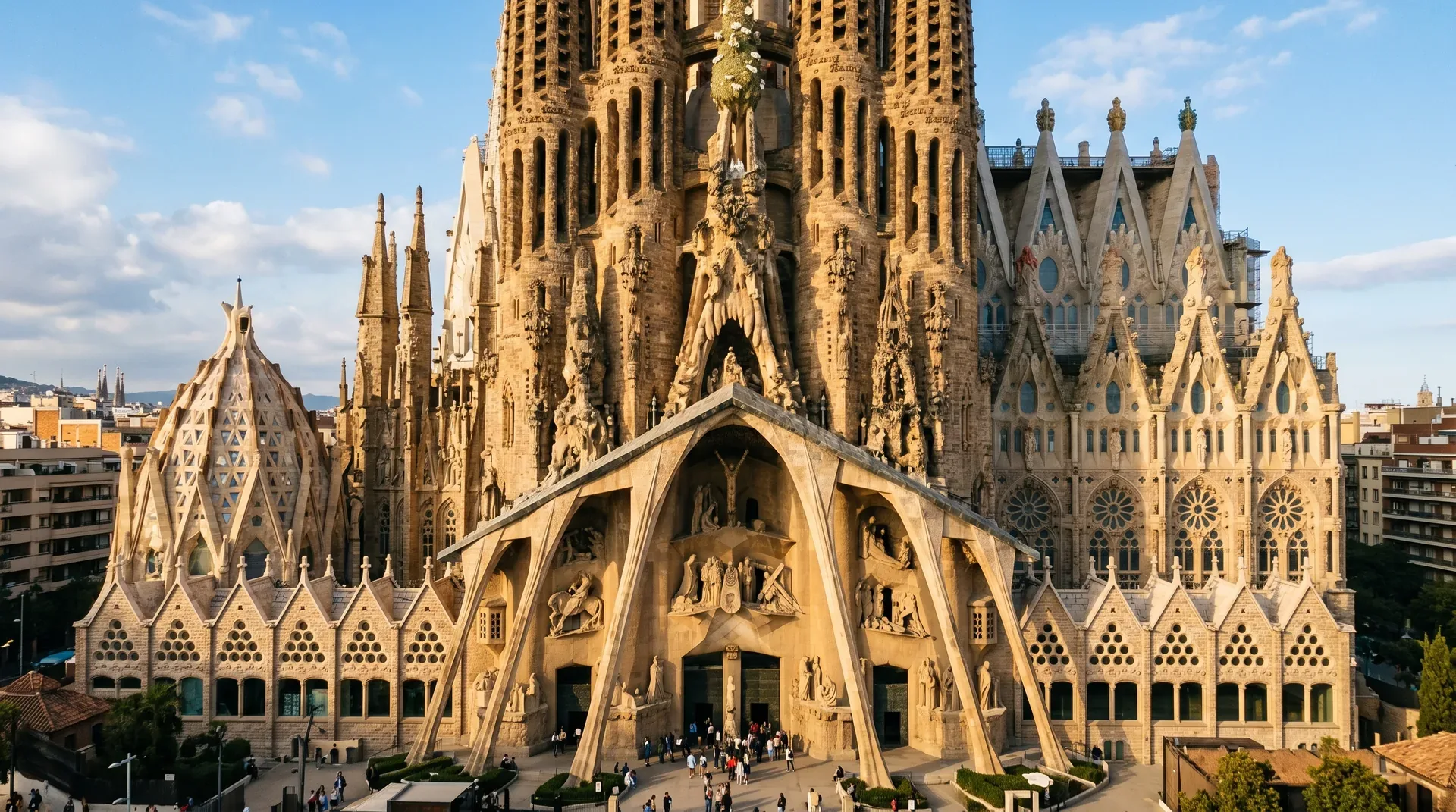
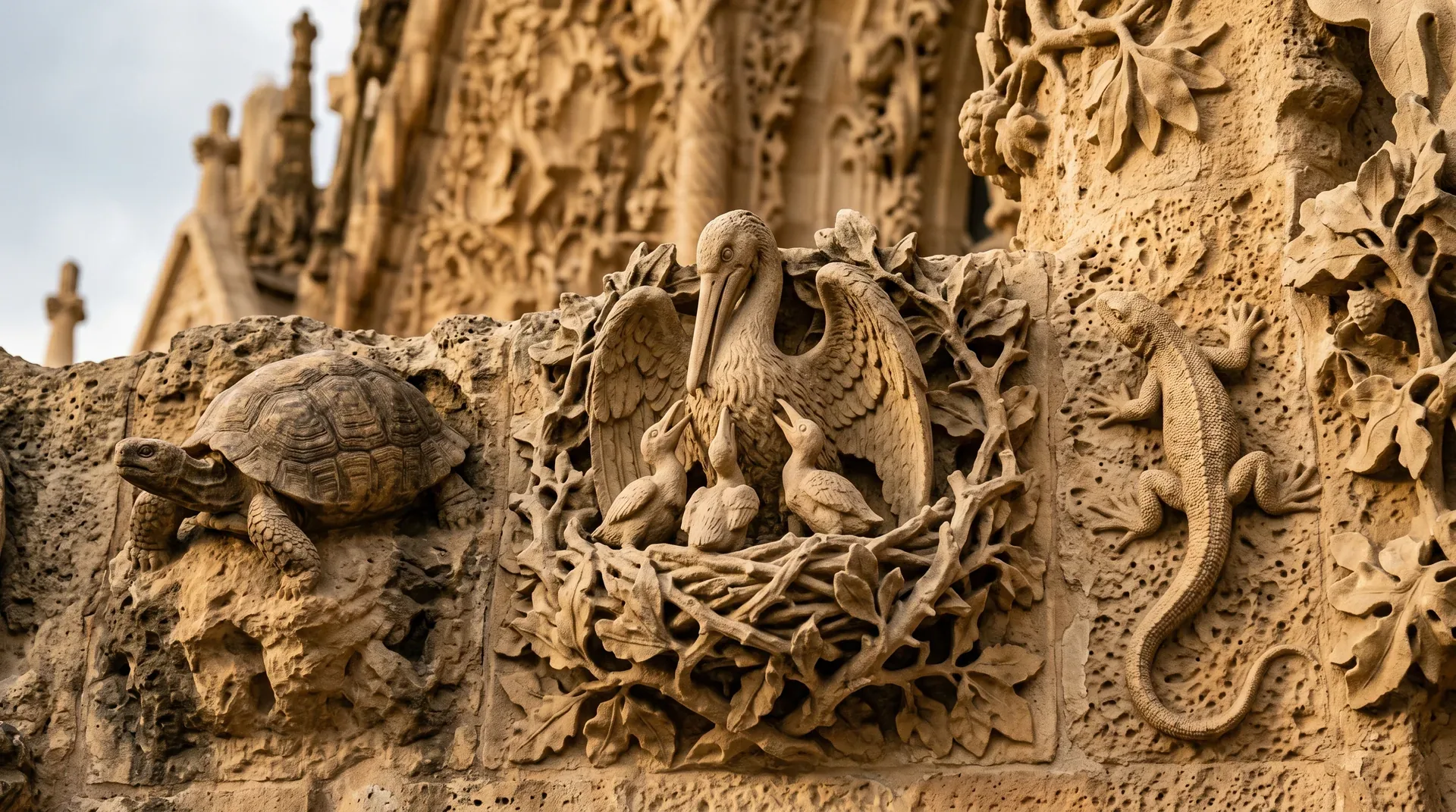
Every element of the Sagrada Família carries meaning. The three facades tell the life of Christ from birth to glory. The 18 towers represent Jesus, Mary, the four Evangelists, and the Twelve Apostles. The stained glass shifts from birth (blue-green, east) to death (red-amber, west). Numbers, animals, plants, and astronomical orientations are all deliberately placed. Gaudí designed a building that teaches Catholic theology through architecture alone.
A Bible in Stone: Gaudí's Symbolic Vision
Antoni Gaudí described the Sagrada Família as "the last great cathedral of the Middle Ages" and as a building designed to be read. His intent was explicit: every surface should communicate Catholic doctrine in a form accessible to anyone — literate or not, learned or not. The building was to be a visual catechism.
This was not metaphorical ambition. Gaudí spent decades developing a comprehensive symbolic programme that integrated architecture, sculpture, number, light, colour, and natural form into a single coherent theological statement. He consulted with clergy, architects, and theologians throughout his life on the project, treating the architecture as inseparable from its meaning.
The result is a building with no purely decorative elements. Every column shape, every animal carving, every number, every orientation of a window serves a specific purpose. What looks like ornament is doctrine.
The Three Facades
Nativity Façade (East)
Birth, life, and early ministry of Christ. Faces the rising sun — hope and new life. Gaudí's original work, most organic in detail.
Passion Façade (West)
Suffering and death of Christ. Deliberately stark and angular — sorrow and grief. Designed by Subirachs after Gaudí's death.
Glory Façade (South)
Resurrection and eternal life. Still under construction. Will be the main entrance when complete.
The 18 Towers
12 Apostle Towers
The twelve smallest towers, four on each facade. Each bears the name and symbol of one of the Twelve Apostles.
4 Evangelist Towers
Matthew (angel), Mark (lion), Luke (bull), John (eagle). Clustered around the central tower.
Mary Tower
The second tallest tower, rising 138 metres. Dedicated to the Virgin Mary, decorated with stars and the inscription "Stella Matutina" (Morning Star).
Jesus Tower (Central)
The tallest at 172.5 metres — just shorter than Montjuïc hill, honouring Gaudí's principle that man should not surpass God's creation. Topped with a radiant cross.
The Stained Glass: Colour as Theology
The stained glass in the Sagrada Família was designed by Gaudí as a symbolic colour journey from east to west. The east-facing windows — those that receive morning light — are in blues and greens. These colours represent life, renewal, water, and the beginning of the story: the Nativity. When morning sun hits these windows, the nave fills with a cool, oceanic light.
The west-facing windows are in reds and ambers. These represent blood, fire, sacrifice, and the end of the story: the Passion and Crucifixion. Afternoon light through these windows turns the nave gold and crimson. Standing in the same spot at 10:00 AM and 4:00 PM produces two completely different emotional experiences in the same physical space.
The high central windows, above both sets, use white and gold glass for the celestial light of resurrection and divine glory. This vertical colour progression — from earthly blues and reds at the sides to heavenly white and gold at the centre top — mirrors the theological progression from human life to divine eternity.
The Magic Square: Numbers and the Age of Christ
On the Passion façade, sculptor Josep Maria Subirachs — who completed the facade after Gaudí's death — carved a 4x4 number grid adjacent to the scene of Judas's betrayal and Jesus being presented to the crowd. Every row, column, diagonal, and quadrant of this grid adds to 33 — the age of Christ at his crucifixion.
Unlike a classic magic square, Subirachs' version uses the numbers 1–16 with some numbers repeated (10 and 14 appear twice, while 12 and 16 are absent). This modification allows more combinations to reach 33. It has generated significant analysis from mathematicians, who have counted up to 310 different ways to read 33 from the grid.
The number 33 is a recurring symbolic thread in Christian theology and appears throughout the building in various forms — the number of scenes depicted in the Nativity facade, the height of certain architectural elements, and structural proportions that Gaudí encoded deliberately.
Animals, Plants, and Natural Forms
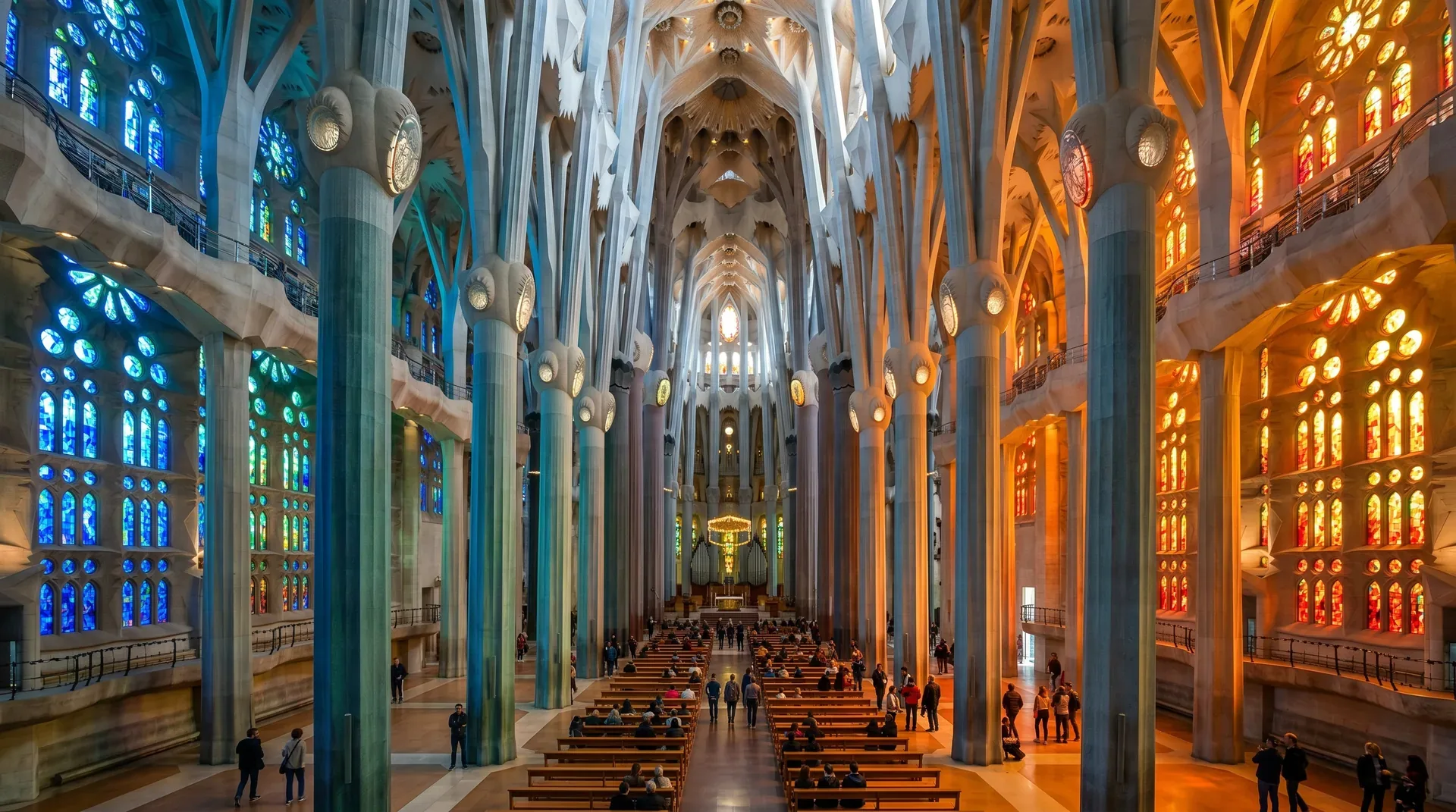
Gaudí drew his symbolic vocabulary from the natural world as much as from scripture. He believed nature was God's architecture and that studying it was a form of prayer. This belief is carved into every surface.
The tortoise at the base of the Nativity facade columns carries the world on its back — the sea turtle on the seaward columns, the land tortoise on the mountain-facing columns. The pelican in the central portal is a medieval symbol of Christ: the pelican was believed to pierce its own breast to feed its young with its blood, an image of self-sacrifice. The dove appears throughout as the Holy Spirit. The chameleon, which changes its appearance, is associated with the transformative nature of the divine.
Inside, the columns branch like trees in a forest — deliberately imitating natural growth patterns rather than classical architectural forms. The branching is not decorative: Gaudí calculated the load distribution using the same mathematical principles visible in natural bone and tree structures. The interior architecture guide covers the column system in detail.