Intimate Sagrada Família Small-Group Tour — Personal Guide, Deep Access
The Sagrada Família is a building that rewards detailed questions. What is that specific figure in the upper left of the Nativity Façade? Why are some of the columns a slightly different colour? How does the building remain structurally stable without flying buttresses? In a large tour group, these questions go unasked or unanswered. In a small group, they become part of the tour. This small-group guided tour is capped at a low maximum to ensure every visitor can hear the guide, ask questions, and receive personalised attention throughout the 1.5 to 2-hour visit.
Tour Highlights
Photo Gallery
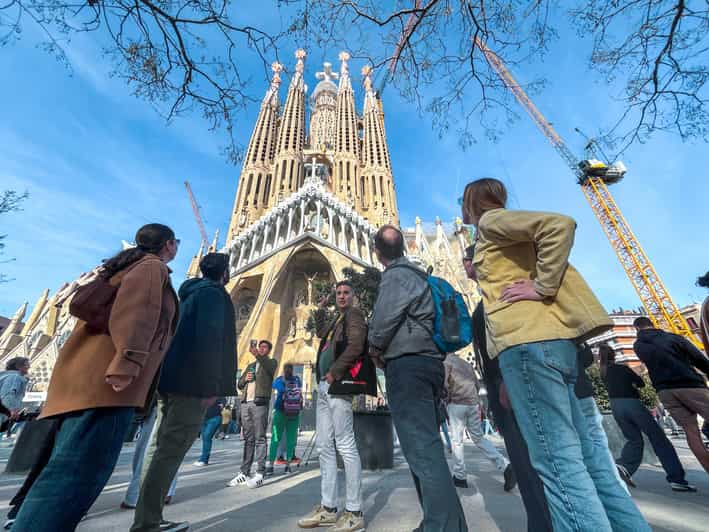
Small-Group Skip-the-Line Tour of Sagrada Família — Personal Guide Attention
Group size is capped to ensure the guide can deliver a genuinely personal experience rather than a broadcast narration. Small-group tours feel fundamentally different from large ones at the Sagrada Família: you can stand closer to the details the guide is discussing, you can ask questions mid-explanation, and the guide can notice when a group member is particularly interested in a specific element and provide extra depth. Skip-the-line entry means you are inside the building quickly and using the full time for the guided experience.
Skip-the-Line Access to Sagrada Família in a Small, Intimate Group
The entry is handled by the guide. The group moves to the priority entrance together and enters within a few minutes of the meeting time. Inside, the small-group format means the guide can stop at any location without creating the kind of foot traffic disruption that larger groups inevitably cause. The stained glass window explanations, for example, work much better in a small group — everyone can hear, everyone can see, and the conversation is two-directional.
Stained Glass, Façades, and Hidden Symbolism
The stained glass at Sagrada Família is not just decorative — it is a programmatic theological statement. The eastern walls (near the Nativity Façade) are composed of warm amber, gold, and ochre tones to represent the light of the resurrection. The western walls (near the Passion Façade) use cool blues, greens, and purples to represent the solemnity of death. Gaudí designed this gradient specifically to create a spiritual journey as visitors move through the building from east to west during the day. Your guide explains this programme and its sources in Gothic light theology.
Why Small Group Makes a Difference
For the Sagrada Família specifically, a small group is a meaningful advantage. The building is simultaneously a museum, a working basilica, a construction site, and a tourist attraction. The interior has acoustically complex spaces where sound disperses poorly. In a group of 20 or more, half the participants cannot hear the guide clearly. In a group of 6 to 10, everyone hears everything. The guide's ability to point at specific details — a particular carving, a ceiling rosette, the shadow pattern through a specific window — is also much more effective in a small group.
What's Included
Not Included
Frequently Asked Questions
Click any question to reveal the answer.